Tuesday, June 29, 2010

Slim pickings

The house that I grew up in had a big picture window above the kitchen sink. I always knew I wanted the same when I found my "forever" home so I was thrilled to find our farmhouse had such an arrangement.

The backdrop to my window view is largely a mix of towering cedar and birch trees, with the bunkie off to the left and the vegetable garden off to the far right. Front and centre is a lovely mature raspberry bush.


Despite looking a bit bedraggled, we were still treated to some delicious berries last year. I wasn't sure what to expect this year as raspberries are biennial but I pruned the canes back in the spring, put down some more straw to keep down the weeds and hoped for the best.

After last year's raspberry escapade, the kids were pretty excited to finally go picking -- but they had a hard time finding more than a tiny handful of dark berries.


With spring coming three weeks early this year, I noticed fruit forming earlier than last year. Unfortunately, this coincided with the early arrival of my nemesis -- the Japanese Beetle, which decimated my roses, peonies and has been seen buzzing around my vegetable garden.

Looks like these beasties found the raspberries too. Can you see the skeletonized leaf? Nasty.
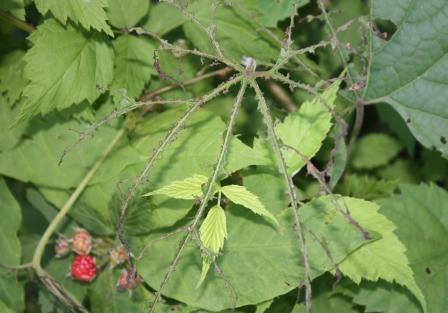
I'm not sure if the beetles are the only reason for our slim pickings this year. Perhaps the canes are too old or maybe the soil needs some TLC. There are still some immature berries on the bush that'll make a nice topping for some homemade yogurt but that's about it.

But this paltry harvest helped reinforce the connection between the growing of food and what shows up on your plate. It was like a mini lesson in crop failure without the hardship and empty bellies. It taught the kids to appreciate what they did pick and not take it for granted.

Together, we're going to do some research so we can figure out how to increase our yield for next year -- but only after we visit the strawberry farm again to get our fill of berries.

Saturday, June 26, 2010

Garlic scapes

I love garlic. Not only is it so good for you and wonderful to cook with, but it's relatively easy to grow -- simply plant the cloves in the fall, tuck them in under a thick layer of mulch and come spring, celebrate their arrival as one of the first garden edibles to make an appearance.

While much attention is paid to what's underground -- the white papery bulbs -- there's an often overlooked delicacy: the garlic scape.

Scapes are the curly whirly flower stems that the garlic produces before the bulbs mature.

It's a good idea to harvest the scapes when they're still young and tender, shortly after they curl, to help direct the plant's energy towards making a bigger bulb.

Simply trim the base of the stem and the flower tips (though I understand some folks eat these parts too). I've read that it's better to harvest scapes in the afternoon so that the wound heals quickly.


Young and tender scapes can be eaten fresh but we found they still had too much of a burn for our palates.

However, steamed for five minutes and then tossed with a bit of butter and a sprinkling of sea salt and oh my, we had a delicious side dish that even the kids gobbled up.


Thanks to my friend at A Little Crafty Nest for teaching me about the delicious scape!

Friday, June 25, 2010

A forgotten harvest

I've got a confession to make: our first harvest wasn't radishes. It was actually lettuce.


I guess I got so excited that after all the digging and planting and weeding in the big garden we finally got to harvest the fruits (or in this case, the vegetables) of our labour, that I'd forgotten about our little patio garden that's been quietly growing just outside our kitchen door.

The Plan is to convert much of the existing house garden to a herb and butterfly garden, but that'll take time and I don't have much of that to spare right now. So besides the basil, parsley, oregano and thyme that I'd grown from seed and transplanted into the big garden to keep the tomatoes and peppers happy, we've got our cooking herbs growing in pots on the deck.

There's oregano, two kinds of basil, sage, thyme, rosemary, dill, chives, coriander, parsley and mint, each with their own delicious texture and aroma.


Besides the herbs, we decided to grow a few pots of lettuce for convenience but also to see how they grow compared to the lettuce growing in the big garden. Already I've come to appreciate one big advantage to pot-grown lettuce -- there are no slugs on the deck!

There's the Tennis Ball lettuce, an heirloom introduced in the 1850's, that produces loose heads measuring only 7" in diameter.


We're also growing a gourmet heirloom leaf lettuce mix, featuring a blend of Green Oak Leaf, Black Seeded Simpson, Australian Yellowleaf, among others.


I always knew there was an incredible range of lettuce varieties far beyond iceberg and romaine. Even the grocery store produce section now offers a hopeful selection of leaf shapes and varieties in pre-bagged mixes. Unfortunately, my experience of those mixes has often been one of disappointment, with the greens being bitter or tough or worse, tasteless.

Growing my own herbs and greens on this little deck garden is not only easy, it's helped heighten my wonder at the range of sensory experiences associated with eating and food. So often we eat just to fuel ourselves, but savouring something as simple as a just-picked herb or a lettuce leaf can introduce a world that stimulates not only the taste buds, but your sense of smell and touch too.

There's an immense sensory delight in gently rubbing herb leaves between your thumb and finger and releasing their rich fragrance. Then there's the intense flavouring that fresh herbs add to a meal -- who knew that parsley could tickle your tastebuds so much? And fresh-picked leaf lettuce has not only an exceptional taste but a gorgeous satiny texture.

Whenever I write about our life here on the farm, I'm always conscious of the fact that not everyone can, or even wants to, do what we're doing here. But the great news is, anyone can do this. It just takes some sun, seeds and soil, and a hunger for eating food that's good for you and the earth.

Related Posts with Thumbnails