Showing posts with label maple syrup. Show all posts

Saturday, March 17, 2012

Backyard sugaring (or how to make maple syrup)

Disclaimer: I realize the title is a bit misleading because this is simply how we made maple syrup from five trees using low-tech methods.

As this is our first year making maple syrup we wanted to do things on the cheap, so our only investment was in traditional buckets and spiles, which cost about $30 (though we could have used recycled plastic buckets had we wanted to). We chose the iconic lidded metal buckets because 1.) I prefer metal to plastic, 2.) we can use them year after year, and 3.) I like the look of them. When I close my eyes and picture a sugar bush, this is what I see.

A bit of nostalgia? Perhaps. But as we're tapping only a handful of trees, collecting buckets is easy and manageable. Even the children enjoy this chore, racing to each tree, lifting the lid off the bucket and tipping the clear contents into the waiting pail below. (We used food-grade wine-making pails that we found in the barn.)

Five almost-full sap buckets nearly fills three 20 litre pails, which can fit side-by-side on a kids' sled (that I can drag when there is snow) or on the back of the ATV (when there is not). The hard part isn't getting the sap out of the trees or the sap into the gathering pails -- it's getting the pails out of the woods, which can be made downright treacherous by the weather (think mud sucking trails laced with patches of ice).


Next year when we tap more trees (we're thinking 10) this bucket method will still be manageable, though instead of the small wine buckets, we'd use a much larger gathering pail that we'd pull by tractor. Still I can appreciate why a growing number of producers, home-scale and commercial, are switching to plastic tubing pipeline systems, which move the sap via tubes that are connected to a centralized collection "vat" in or near the sugar shack.

Sandy Flat Sugar Bush, Warworth, Ont. March 2010

This is certainly a more efficient collection method, but it is more expensive to purchase up-front, more time consuming to set up and can require ongoing maintenance due to squirrel damage. What's more, something of the sugar bush lore and romance is lost when the trees look like they're connected to an elaborate IV.

As we're simply interested in making maple syrup for our own consumption, I quite like the slow and simple process of gathering buckets. Much of our traditional ways have been lost in the quest for greater efficiency, and while we may be able to harvest more sap for less time and effort by using more "advanced" technology, the experience and link to tradition would be lost.

Source: Little House in the Big Woods by Laura Ingalls Wilder

In keeping with our low-tech, minimal cost approach, we, too, decided to boil the sap down over an open fire. Larger hobbyists and commercial producers use evaporators, but even a small evaporator for up to 150 spiles would set us back $3,000.

We didn't have a big iron kettle like the pioneers used, so instead I built a rough three-sided "oven" out of cinder blocks in our fire pit and topped it with an old grate. Lucas found a stainless steel stock pot on sale ($13) and we used that for our main boiling pot. (I think it's only a 12 quart size and while a larger pot or shallow pan might have been better, we wanted to make use of what we had or was readily available.)

I had a second pot (not shown) that I used to pre-boil the sap, so as the larger pot boiled down, I added the pre-boiled sap to it to keep the temperature fairly constant (unless the sap in the larger pot threatened to boil over and then I'd add cold sap to cool it off).


I didn't need to sit there the entire time, but I did enjoy several hours of quiet contemplation at the fireside watching the steam billow and the sap dance over the glowing coals as the fire hissed and crackled. Pure magic.

It took about seven hours to boil roughly 55 litres of clear sap down to 4-5 litres of thin golden syrup. At that point, I brought the sap into the house (while it was still hot) and filtered it into another stainless steel stock pot. While I'd already filtered the sap once in the woods, to remove the bugs and pieces of bark, quite a lot of particulate matter (from ash, cinders, etc.) had collected in the boiling sap. It's also wise to remove the gritty sediment called 'sugar sand' (or niter), which is minerals and nutrients from the trees that concentrates as the sap boils down.
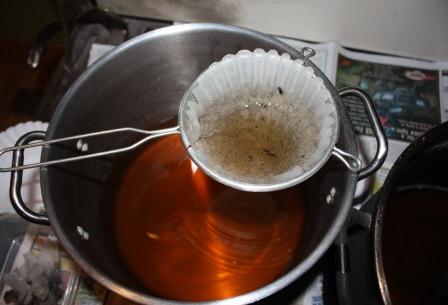
I then put the remaining sap on the stove top to finish it. As I'd already boiled most of the water off outside, I didn't need to worry too much about excess condensation in the house (as sap is only 3 - 5% sugar and the rest water, sugaring inside the house can peel wallpaper and invite mould into the walls), but I used the vent fan all the same.

Finished sap boils at approximately 103.8 degrees Celsius (218.8 degrees Fahrenheit) (at sea level). It's important to keep an eye on the sap/syrup as you approach this point because as the concentration of sugar increases, less water is available to boil away, which means the syrup can easily boil over and/or burn.

If you let it boil too long as I did with our first batch, it'll start to thicken and crystallize. (Ironically, this happened as Lucas and I were arguing over whether the sap/syrup was ready yet. Guess he was right.)


The above syrup has a creamy consistency flecked with granulated maple sugar bits and is delicious in coffee, drizzled on ice cream, smeared on toast, eaten by the spoonful...

I was much more careful with the second batch and while I didn't have a candy thermometer handy (I broke it with the first batch) or a hydrometer to check the density of the maple (finished syrup is roughly 65% sugar) I'd say this one turned out perfect -- deep amber in colour with a smokey rich sweetness.

Sugaring season is short, with most sap coming during a 10 to 14 day "run," depending on the weather. We'll continue to collect sap and make syrup until the buds open and the trees stop producing. With this strange spring, that may come sooner than we hope.

Like many of our "simpler" pursuits, there is a lot of time and work involved transforming sap into syrup, especially when making it the traditional way. But this process fosters a deep appreciation for the gift that nature provides us and helps create a connection to the folks who settled our land and had their own sugaring-off celebrations. If these trees could talk, I'm sure they'd have many sweet stories to tell. Instead, we're sharing our own.

Saturday, March 10, 2012

The view from here


Friday, March 9, 2012

Full

With the balmy weather this week, the maple sap has been flowing like mad. When I went to check the trees yesterday, all five buckets were full like this. It took me two trips to haul it all out of the sugar bush.

We've got more than 50 litres of sap already, so I'll start boiling it down today outside over an open fire.

On Wednesday I was hanging out with the bees; today I'm making maple syrup. When the work and school day is done, my family will join me to roast marshmallows around the fire.

This kind of living offers as many challenges as it does joys, and there are days I feel tired and spent and overwhelmed. Then there are days like today when I feel so full -- full of gratitude and love for my life.

Saturday, March 3, 2012

Drip...


Enough of these for a collection of nine-and-a-half litres today,
and that was with two buckets (out of five) downed from a massive windstorm.

Man, I freakin' LOVE this!

Wednesday, February 29, 2012

First sap!

While we tapped some trees on Saturday, three days passed before I got a chance to check the buckets. So after finishing barn chores yesterday morning, I took the dogs for a walk on our usual loop, which passes through the woods where we're tapping.

As I walked towards the buckets I wasn't sure what to expect. Would there be any sap? Did we even tap the right trees? The temperature had been below zero the last few days, so I told myself, "don't be disappointed."

I lifted the first lid and let out a loud whoop -- sap!

There was only about 4" of accumulated sap on the bottom of the bucket, and approximately 2" of it was frozen solid, but it was maple sap all the same.

I emptied all four buckets -- the first two much fuller than the buckets on the old tree that we'd double tapped (I think we're going to move one of the spiles to another younger tree) -- and dragged the slushy sap home using a sled I'd expropriated from the kids.

I left it to fully melt and then measured it -- approximately 2.5 litres! I felt a bit silly being this excited about our first harvest as this amount of sap will yield only about 1/4 cup of finished syrup, but I was giddy. Ridiculously so.

Until I took Jack to hockey last night. It seems everyone around here is tapping trees. The first woman I talked to already has 300 spiles in, and hopes to tap 100 more. She said they'd max out their taps at 500 trees as that's about all they could handle this year.

I was more than a little sheepish when I told her that we'd tapped just four trees, because we thought that was all we could handle this year. I started thinking, maybe we should tap some more -- we could do at least 10, right? Or 15? Or...

Then I caught myself doing that thing that I always do. I compare myself to what other people are up to, and I never seem to measure up. Folks are always 'further ahead' on their homesteads and farms, doing more, achieving more, and I often feel like I'm just dabbling, or when I'm really hard on myself, I feel like a fraud. I'm not a particularly competitive person and yet I always seem to be keeping score.

Since moving to the farm I've become horribly impatient. I want to do it all -- grow food, raise animals, live the "good life" in our ultimate efforts to become more self-reliant -- right now! But I too often forget (or ignore) that it's the journey that matters, not the destination.

I'm learning most of these skills from scratch, while raising two kids and working three jobs. I know I should cut myself some slack, but it's hard. I waffle between feeling like an underachiever and feeling totally burnt out and exhausted.

What we're doing is enough. I'm enough. And even if we only harvest enough sap to make one bottle of syrup, it's one more bottle of homegrown goodness than we had last year.

So in the spirit of celebrating another first, before the kids left for school this morning I passed around a tiny sherry glass and we each took a sip of this spring tonic.


It was a sweet way to start a new day and a new season. It was enough.

Tuesday, February 28, 2012

Tapping the trees

Saturday marked our first time tapping the trees in 'the old sugar bush'. To get there you must first walk through the big hayfield towards the south-east corner of our farm, a crossing made easier by our snowshoes, which have had little use in this wet but mild winter.

It was my favourite kind of winter day, cold but sunny, with a healthy base of snow (thanks to Friday's storm), which felt dense and solid under our footfalls. We walked single file through the outskirts of the forest stand, with its mix of young maples, evergreens and sumac.

The cedars gave way to the oak trees and then rounding a corner we passed into the part of the woods populated by some sugar maples. We had a hazy sense of which trees were maples, but without any leaves we couldn't be 100% sure.

While we'd meant to mark the trees last fall, we didn't, and the monochromatic winter forest is markedly different from its green and leafy warm weather persona -- it's more quiet and reserved.

Undeterred, or just plain stubborn, we located two of the trees that we'd eye-marked last weekend based on what we thought was classic maple bark design, and decided we'd hang just two buckets here. I've come to appreciate that book learning can only take you so far; the true teachable moments come from experience.

We drilled the first spile...

...and hung the first bucket.

The lid barely had time to close before the kids clammered around, looking to see the first sap flow. But the trees were still sleeping on this cold morning.

While the kids and Lucas searched for suitable trees on the other side of the trail (to hedge our bets in case we'd misidentified the first two) I remembered one special maple that I'd found last summer .

I know so little of the history of our farmstead, so when I first learned about 'the old sugar bush' during an unexpected visit last August from a woman who told me she was "born here 70 years ago", I checked the sugar maple tree trunks for some evidence of their productive past.

I found only one spile scar. At the time I was disappointed, but this day it was enough.

I used that same scar as a map (of sorts) to show us where to hang two more buckets

Nature has much to teach us if we open our eyes and look -- with a little help from those that came before us.

Wednesday, February 22, 2012

The bookish farmer: "Maple Sugar" by Tim Herd

Folks who know the history of our farm often talk fondly about 'the old sugar bush.' Today when we walk through that part of the woods, the stand is largely made up of very, very old and very young maples. But like the Goldilocks story, there are some maples that are 'just right' -- just right for tapping, that is.

We're big maple syrup fans and we love its woodsy sweetness on -- and in -- everything from pancakes to baked goods and even coffee. Other than honey (also a family favourite!) and agave nectar, it's the only sweetener that occurs naturally in a liquid state. It turns out that our reverence for this sweet treat is many, many, many generations old. While its exact origin is unknown, Native Americans have many legends about the discovery and early usage of maple sap.

One tells of the Earth Mother, Kokomis, who made the first maple syrup and allowed it to pour freely from the trees. Her grandson Manabush, who worried that if the syrup could be obtained so easily people would become lazy, climbed to the top of the maple tree and showered it with water, thus diluting the syrup to sap.

This is just one of the fascinating pieces of maple lore that I learned reading Tim Herd's book, Maple Sugar.

While the book is small in size (144 pages and measuring 6.5" x 7.5", only a bit bigger than a CD case), it's packed full of interesting tidbits about the history, early sugaring methods and uses of maple syrup.

There's also a chapter on tree identification, with notes on the top six (out of 13) species tapped by hobbyists, and a fascinating overview of the four seasons of the sugar bush. Amateur botanists and dendrologists will appreciate the brief, but interesting, chapter on the "Secret Life of Trees."

Rounding out the book is a chapter on the how tos of commercial maple syrup production, with gorgeous photos of rustic sugar shacks housing modern-day evaporators (interesting juxtaposition, I'd say).

The second-to-last chapter is geared for the Do-it-yourself and provides step-by-step instructions on identifying trees, finding equipment, tapping and of course, sugaring. The last chapter provides a number of simple recipes that showcase this springtime bounty.

Despite the book's small size (it's more a primer than manual), it was the DIY chapter that really caught my eye, especially the suggestion that each tap on a healthy tree may produce 10 gallons of sap (or more) during the month-long season. As it takes 40 gallons of sap to make one gallon of syrup (1 U.S. gallon = 3.785 litres), just four tapped trees (one stile per tree) could potentially keep our family in delicious maple syrup for a few months!

Photo from 2010 visit to Sandy Flat Sugar Bush in Warkworth, Ont.

That's what makes this book so inspiring -- it makes you want to run out and start tapping trees right now! (Like I need more inspiration -- it's more hours in the day that I need.)

I approached the idea with Lucas and while he usually provides a moderating effect on all my crazy "we could do this!" suggestions, he, too, loved the idea.

So last week we took the kids for a walk through the 'old sugar bush' and marked a few trees. (Note to self: this is much easier to do when the leaves are on the trees!) Tomorrow I'll go to our local farm supply store to pick up a few metal spiles and buckets, and then I'll go through our stockpile of food-grade buckets in the barn and find (and sterilize) several for collecting the sap. We're still trying to find some kind of container to boil down the sap (Herd suggests a large shallow pan, though if anyone has an extra cast iron cauldron kicking around, drop me an email!), but we've agreed that we're going to do this old-school, over an open fire. That's the plan, at least.

Local farming friends tell us the sap is already flowing and many commercial-scale Ontario producers kick off the beginning of maple syrup season with a "First Tapping" ceremony this weekend. While we usually mark the arrival of spring with a visit to a local sugar bush, this year we're excited to be starting a new tradition deeply rooted in our backyard.
Related Posts with Thumbnails